- Tuesday 01 April 2025
New Wave Mental Maths is a flexible, yet structured series designed to support different teaching styles. The series can be used to quickly and effectively consolidate learning so that you can identify and fill learning gaps without constantly having to re-teach concepts.
Written by long-standing series author Eddy Krajcar, the books support the regular revision of previously taught maths concepts, as well as reinforcement of ongoing mathematical concepts.
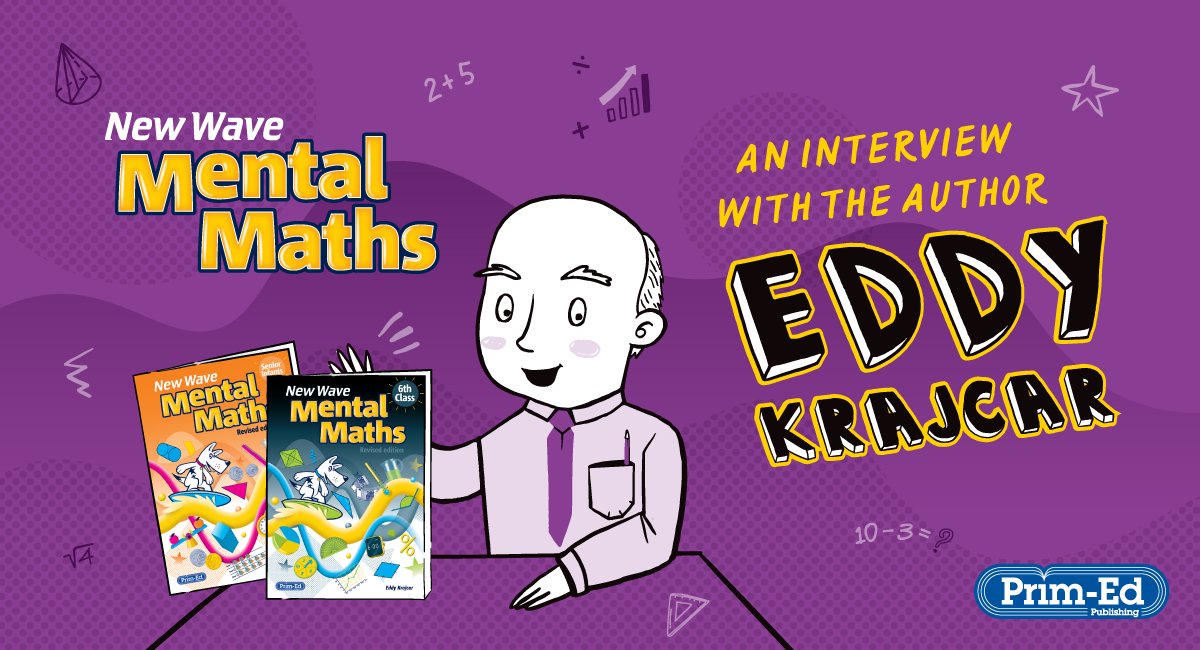
We here at Prim-Ed Publishing were lucky enough to sit down over a cup of coffee with Eddy to chat about his journey writing the New Wave Mental Maths series and discuss some of the unmissable features of the latest revision.
Interview:
Prim-Ed: Thanks for joining me, Eddy. You’ve been writing this series for over 25 years now, and I can tell you, I wish I’d had these books when I was a pupil. Tell me how the concept for New Wave Mental Maths first came about.
Eddy: It started from teaching kids who had trouble telling the time – I noticed there were gaps in what they did and didn’t know, so I started teaching concepts to bridge these gaps I was seeing – and it’s evolved into what New Wave Mental Maths is today.
Prim-Ed: It’s amazing to hear how such a small event can lead to something so impactful. Teachers love these books – can you shed any light on why you think that might be?
Eddy: Well, it saves them a lot of time because teachers don’t have to reinvent the wheel or figure out how to fit a complicated resource into their program of work. And it’s stimulating for pupils – it keeps them engaged in the material for a short time without overwhelming them with too much information.
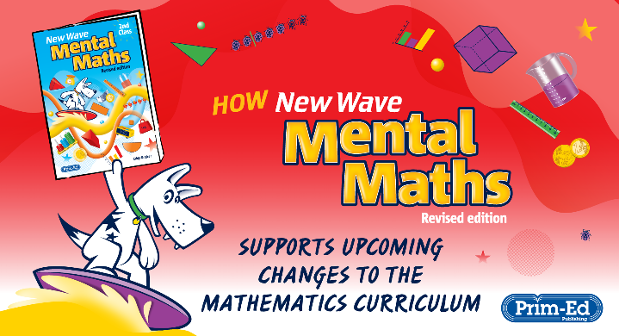
Prim-Ed: New Wave Mental Maths has undergone two decades of continuous research and development. Can you tell us more about the new features and elevations in this revision?
Eddy: When the updated Primary Mathematics Curriculum was announced, we began brainstorming what new features we could add to the revised series that teachers would love. Two additions that I think will be big hits are the ‘Maths Talk’ and the ‘Vocabulary’ columns, which offer opportunities for class discussion and assess pupils’ maths literacy. We’ve also introduced a ‘Weekly Focus’ section that provides a specific topic that can be taught, then practised, throughout the week. I’m excited about these new features because they mean teachers can meet learning requirements while ensuring all pupils are able to grow their interest and skills in maths.
Prim-Ed: The ‘Maths Talk’ section sounds like an important new feature – what can you tell me about it?
Eddy: The ‘Maths Talk’ concept stems from the new Primary Maths Curriculum. This initiative has been introduced to encourage pupils to discuss and experiment with strategies to solve maths questions. It’s an ideal opportunity for the teacher to check in on their pupils’ deeper understanding of a taught topic. Plus, approaching a concept from a different point of view engages the kids’ critical thinking skills, and shakes up the pace of the lesson through partner- or group-work.
Prim-Ed: The ‘Friday Review’ has been a pillar of the New Wave Mental Maths format. Why is it so well regarded?
Eddy: The ‘Friday Review’ is a revision of what was covered in the ‘Daily Practice’ columns that week. It’s designed to help teachers gauge whether each pupil is grasping various mathematical concepts – this is why many teachers like to use it for a quick assessment at the end of the week. As educators, we want pupils to see what they are great at and also what they may need to work on. It’s important for their individual development that we help fill any gaps we see.
The ‘Daily Practice’ column questions are designed to include easy, medium, and hard questions to make sure that all skill levels are catered to. In the revised edition, we’ve added more real-world problems, but we’ve still got those all-important maths building blocks for consistent reinforcement.
Prim-Ed: I can see how that ties into the ‘Practise’ aspect of our Practise, Consolidate, Reinforce methodology at Prim-Ed Publishing. I’d love to hear more about how these features help pupils deepen their learning.
Eddy: In the ‘Friday Review’, we’ve got colour-coded questions that align to the curriculum maths strands; for example, purple for Algebra, green for Measures, and so on. This helps teachers out when assessing their pupils, allowing them and their pupils to understand which concepts they still might not understand.
Prim-Ed: I see – so if a pupil needed to work on counting …?
Eddy: If a teacher spent a week working on counting forward, the following week could be used to focus on counting backwards – but the questions should still include concepts about counting forward too to help the pupils see the relationship between the two types of counting. Through this process, the pupil is given the opportunity to practise previously taught skills and build on them to develop new ones.
Prim-Ed: And the teacher knows what they’ve already covered?
Eddy: Yes, the colour-coding in the Friday Review means that both the teacher and the pupils can monitor their understanding of each topic and the related concepts. The ‘Daily Practice’ columns are structured in a way that reminds the kids that they’ve worked on similar concepts in the previous week and that they are building on their skills week-to-week. A previously learnt concept then might reappear four or five weeks later, to highlight and reinforce those key maths areas. This also saves time for educators because they can easily identify and hone in on what content is most important to cover.
Prim-Ed: Have you still been teaching while writing the New Wave Mental Maths series?
Eddy: Yes, I have. I feel it’s important to test my product and maintain my maths skills and knowledge as curriculum changes are made. Being in the classroom gives me a first-hand perspective of what both teachers and pupils need from these books to succeed.
Prim-Ed: Well, this has been wonderful and I’m glad I had the opportunity to speak to you personally about the series. Thank you for your time, Eddy!
Eddy: No worries. You can thank me by letting me eat the last biscuit!
_____
We hope you loved this interview with Eddy. If you want to see more interviews, let us know!
And, if you want to learn more or shop our revised series, visit the New Wave Mental Maths page.